
Drone Services
Solar & PV Inspections
Panel by panel. String by string.
Whole-array coverage, not a 10–25% sample.
Underperforming panels, hotspots and cell degradation are invisible to a visual walk-through and easy to miss with manual sampling.
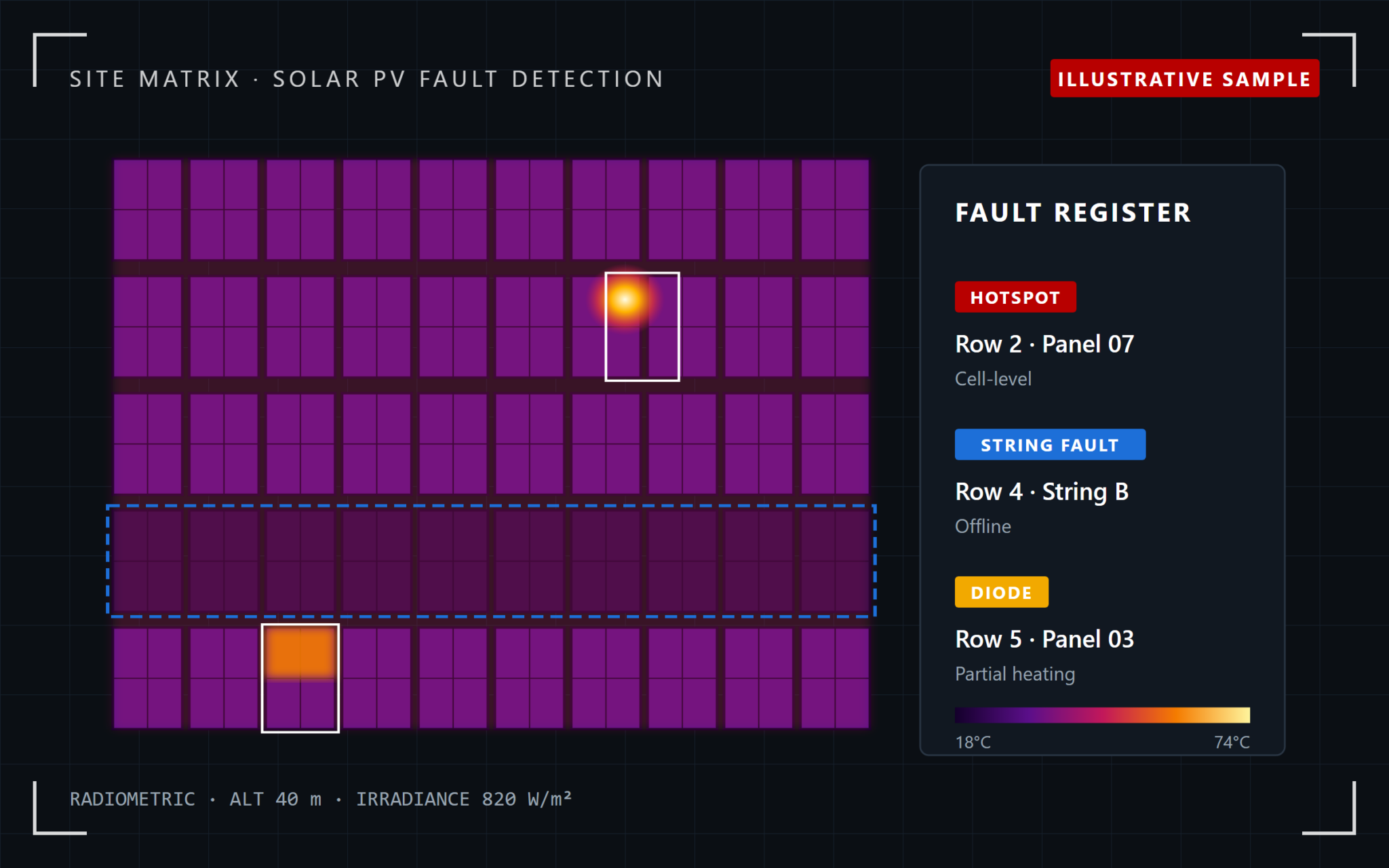
We inspect the whole array — thermal and visual — and map the faults we detect to their panel and string.
‘The fault could be anywhere in the part of the array nobody checked.’
The problem: sampling misses faults
Most programs check a fraction of the array.
Ground-based thermal sampling on a commercial array is slow — roughly 25 technician-hours per megawatt on foot — which means most inspection programs check a sample, not the whole array.
Full-array inspection closes that gap
Commonly completed by drone in around 10 minutes per MW — and the array stays online.
How we solve it
Capture. Classify. Report.
Full-array capture
Thermal and visual,
wall to wall
The whole array in a single flight campaign, not a sampled walk-through
Fault classification
Cell, module and
string faults separated
Because the fix and the urgency differ
Report to panel / string ID
A fault register your
team can act on
Geo-tagged and mapped to the array layout
What we deliver
From hotspot to warranty claim
What the data shows
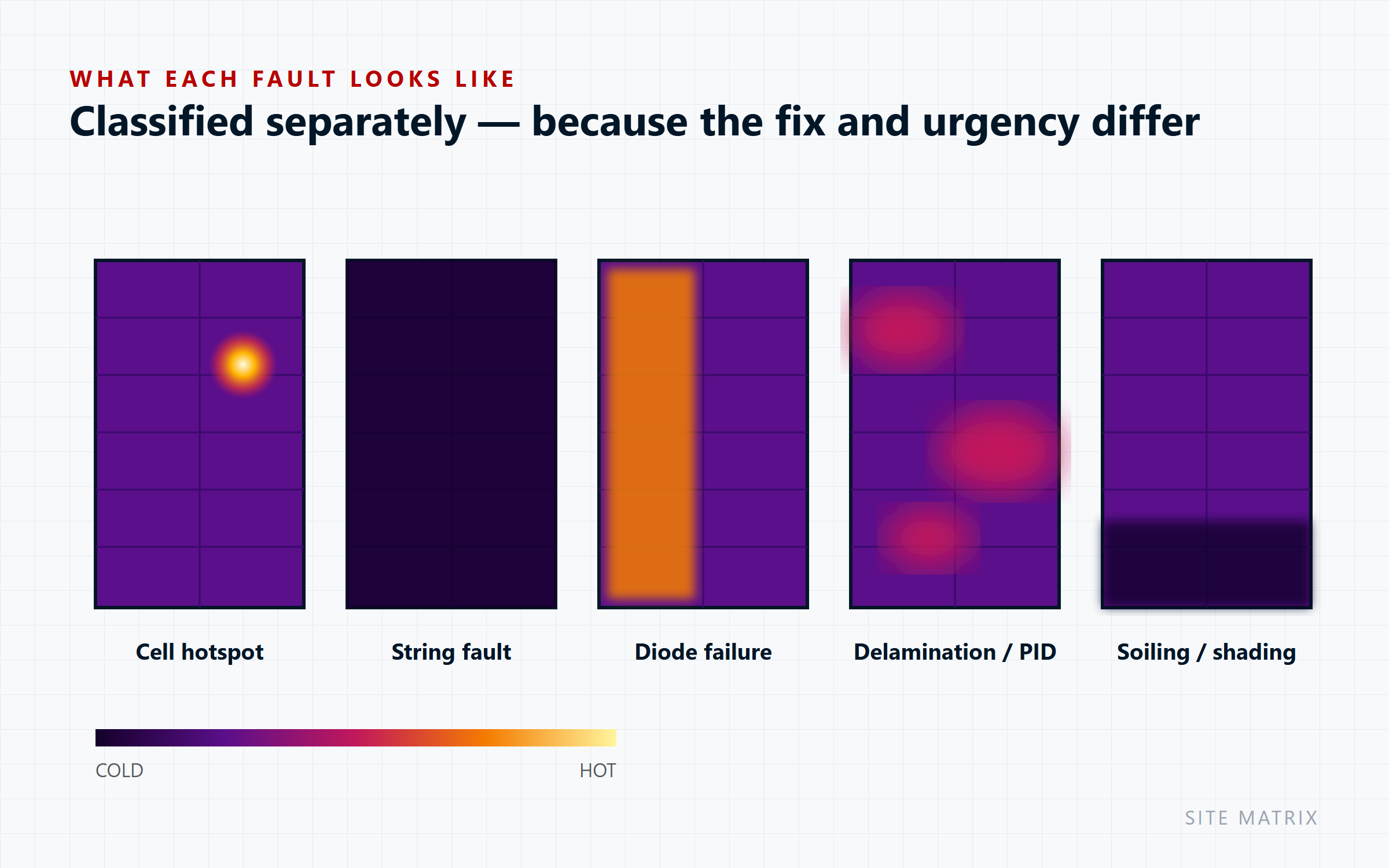
What each fault looks like
| Fault type | What it looks like |
|---|---|
| Cell-level hotspot | A small, intensely hot point on an individual cell — often the earliest sign of degradation |
| String fault | An entire string running cold relative to the rest of the array — offline, producing nothing |
| Diode failure | A bypass diode malfunction shows as a characteristic partial-panel heating pattern |
| Delamination / PID | Diffuse, irregular thermal patterns across a module, distinct from a sharp cell-level hotspot |
| Soiling / shading | Cooler-than-expected cells where debris or shade reduces output, without an actual fault present |
Why it matters
More output, stronger warranty claims
Whole-array coverage
The whole array surveyed each visit where conditions allow — not a 10–25% sample.
Minutes, not technician-days
~25 technician-hours/MW on foot, commonly ~10 minutes/MW by drone.
The array stays online
No shutdown required to inspect it.
Supports warranty claims
Located, dated, imaged evidence of a defect while it’s still within warranty.
Typical outcomes
Commercial solar PV fault detection
Who we work with
From owners to installers
Asset owners & investors
O&M contractors
Installers & EPC contractors
Every month a fault goes unfound is output you don’t get back. Inspect the whole array.
Your questions answered
Frequently Asked Questions
Does the array need to be shut down?
No. The array stays online — thermal inspection relies on it operating under load.
Can you map faults to our panel layout?
Yes. Findings are geo-tagged and reported to panel and string ID so your O&M team or installer can act directly.
What happens if it’s too windy or rainy to fly?
We reschedule at no cost. Flights only go ahead within CASA-compliant weather and wind-speed limits, to protect both safety and data quality.
Who owns the data and imagery?
You do. All captured data, imagery and reports become your property on delivery; we retain a copy for our own records only.
Are you insured and licensed?
Yes — all flights are conducted under our CASA ReOC (9692) and a current RePL, with commercial liability insurance in place.