
Your Insulation Could Be Failing. You Just Can’t See It.
How Buildings Lose Heat, Part 1: Conduction
Buildings lose energy two ways: through solid material (conduction) and through moving air (convection).
This post covers conduction — and why the insulation you paid for may not be doing its job.
Insulation Only Works If It’s Installed Right
Insulation works by trapping still air. Crush a batt against a purlin, staple it too tight or pack it into a cavity that’s too small, and the air is squeezed out. The material is still there, but it now conducts heat instead of stopping it.
That’s why R-value is only meaningful as installed. A batt compressed to half its thickness is nowhere near its rated performance — and nothing on the surface will tell you.
Why a “Good” Wall Can Look Cold
Viewed from inside a heated building in cold weather, a well-insulated wall and an uninsulated one show opposite thermal patterns:
Properly insulated
Cold studs, warm cavities. Timber conducts more heat than insulation, so the studs read cooler. That’s a wall working correctly.
Missing insulation
Warm studs, cold cavities. With nothing in the cavity, heat pours straight through and the pattern flips.
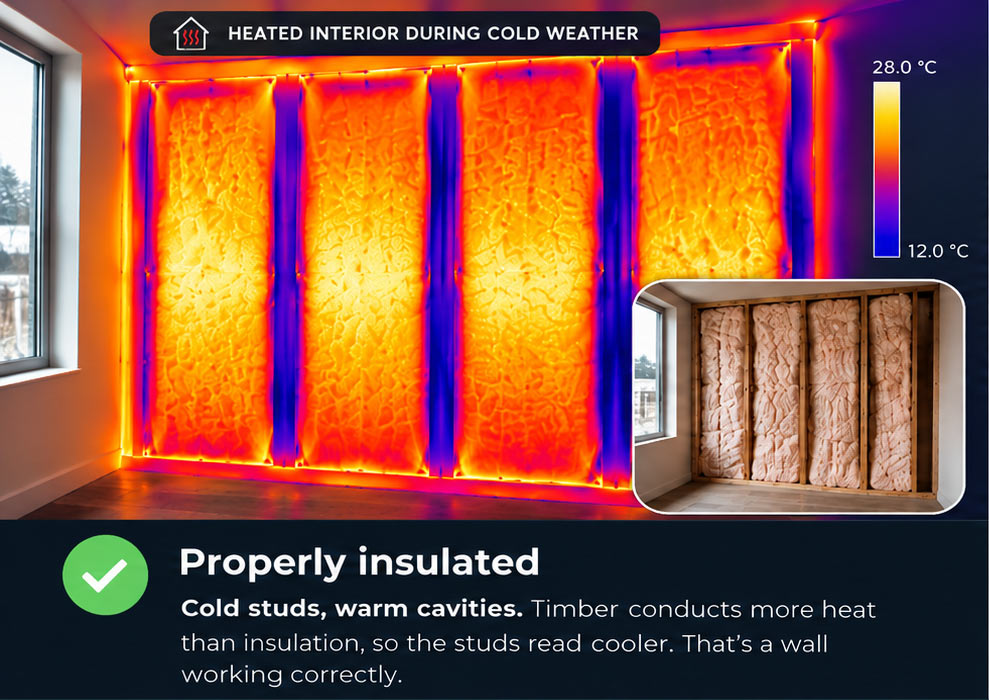
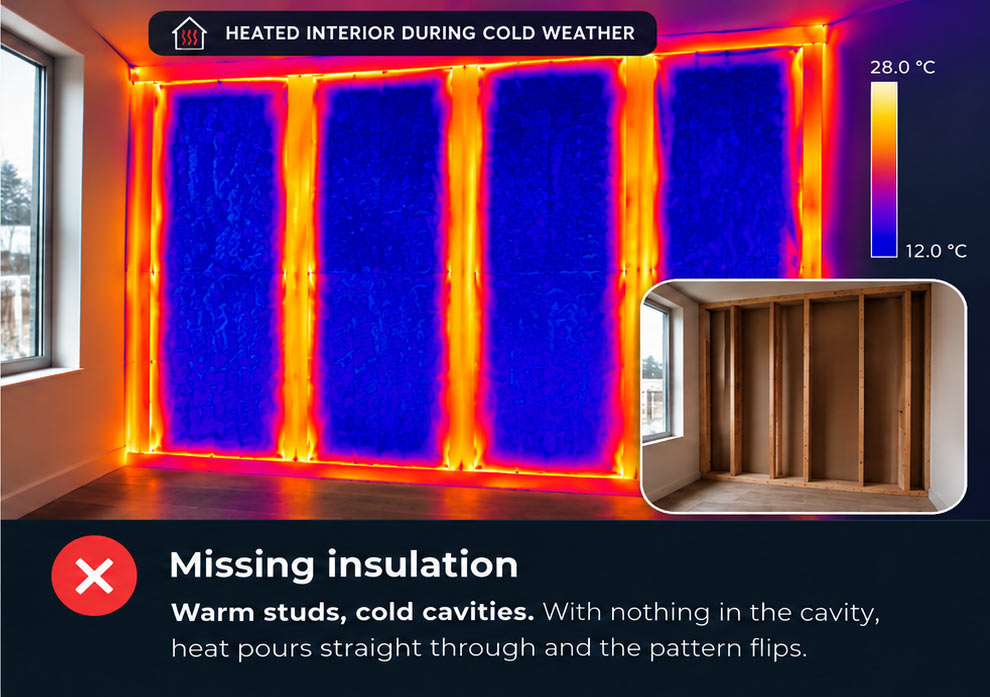
Read it the wrong way round and you get a confidently wrong report. The camera is only half the job — interpretation is the other half.
Not Sure Your Insulation Is Performing?
We’ll show you exactly where your building is losing heat — located, imaged and explained.
Timing Is Everything
Defects only show when there’s a real temperature difference across the building envelope. Too small, and they stay invisible. That makes energy analysis seasonal — the right window is limited.
Minimum inside-to-outside difference, held for 3+ hours
0
°C
Why Site Matrix
Anyone can point a thermal camera at a wall. We tell you what it means — and what to do about it.
Engineering-led interpretation
We read the physics, not just the colours — so you don’t act on a pattern that’s been read backwards.
Defensible reporting
Every finding is located, imaged and paired with a daylight photo and conditions — ready for warranty, insurance or defects claims.
Buildings to plant
Facades, roofs, air leakage, pipework and refractory-lined boilers, kilns and furnaces — one team, one method.
Next in the series: Part 2 — Convection. Air leakage, stack effect, and why the side you inspect from changes everything. Explore our thermography services →